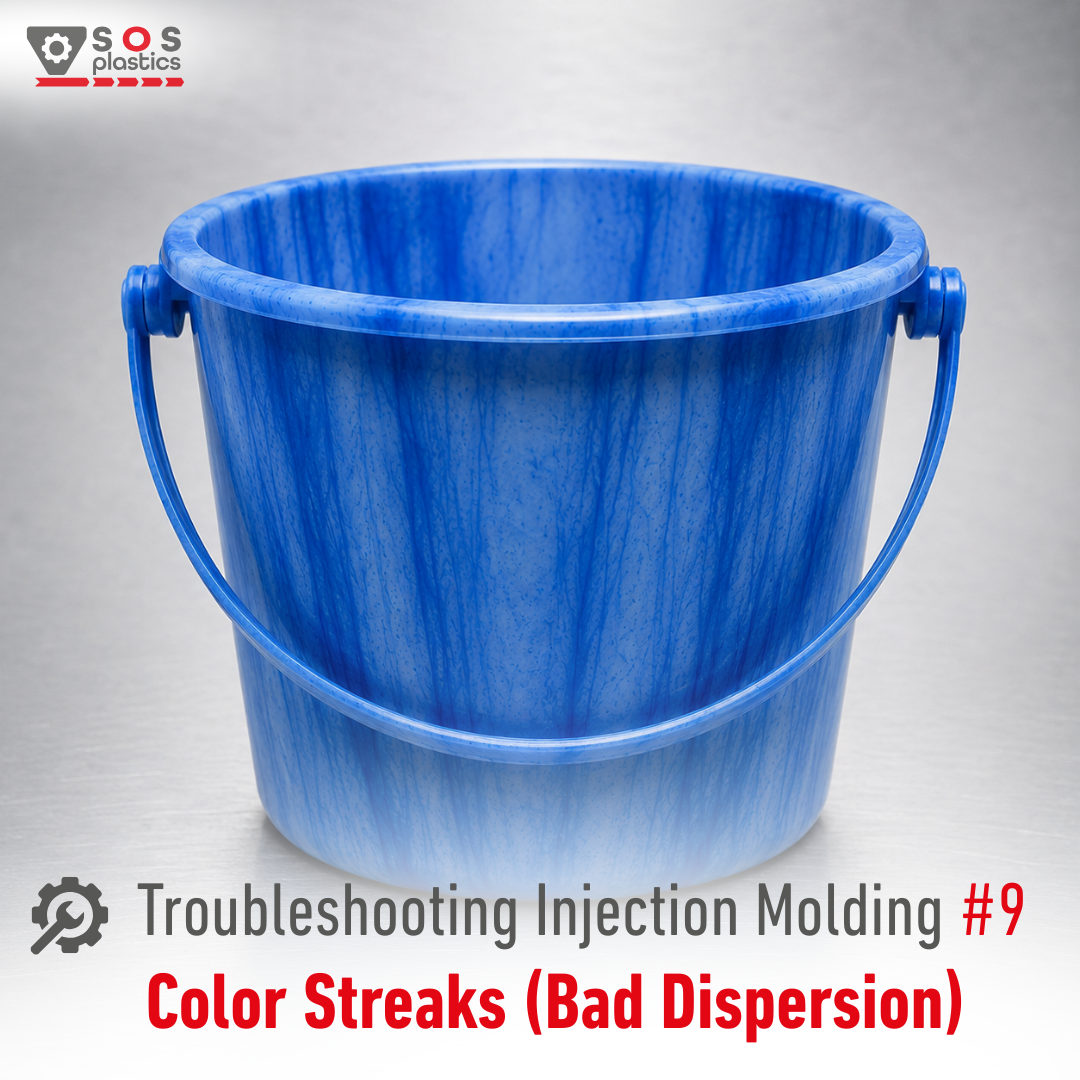
Color Streaks are often created by the plasticizing process, flow conditions, or pigment orientation rather than by the color concentrate itself.
Material must be properly stored and dried (when required), processed within the recommended temperature window, and actual melt temperature should always be verified rather than assumed.
Color Streaks are visible color variations, stripes or bands on the molded part caused either by poor pigment dispersion or by unfavorable pigment orientation during filling.
When troubleshooting Color Streaks, investigate the causes in the following order:
1️⃣ Poor pigment dispersion (most common cause)
➡ Verify whether the masterbatch is mixing uniformly with the base resin. Check dosing accuracy, blender performance and material homogeneity.
2️⃣ Incorrect plasticizing conditions
➡ Increase back pressure if necessary and reduce screw recovery speed to improve melt homogenization. Verify the actual melt temperature before making further adjustments.
3️⃣ Unsuitable screw mixing capability
➡ If the process is stable but streaks remain, evaluate the screw design. A mixing section or mixer head may significantly improve pigment dispersion.
4️⃣ Masterbatch compatibility
➡ Confirm that the masterbatch carrier is compatible with the processed polymer and that pigment concentration is appropriate for the application.
5️⃣ Unfavorable pigment orientation (especially metallic pigments)
➡ If streaks follow the flow pattern or appear near weld lines, gates or flow transitions, review filling sequence, injection speed and gate location. In these cases, the pigment orientation (not dispersion) may be the root cause.
6️⃣ Thermal degradation of pigments or polymer
➡ If color changes are accompanied by burning or discoloration, reduce melt temperature, residence time or excessive shear and inspect the machine for dead spots.
⚠️ Not every Color Streak is a dispersion problem. Metallic pigments often create streaks because they become oriented differently during filling rather than because they are poorly mixed.
⚠️ Before replacing the masterbatch supplier, first optimize plasticizing conditions. In many cases, increasing melt homogeneity completely eliminates the defect.
⚠️ If the defect always appears in exactly the same location, investigate mold design and flow pattern before changing material or machine settings.
Next in the Plastic Troubleshooting Series:
➡ Surface Gloss Variations (Matte / Shiny Areas)
How do you deal with a problem of Color Streaks in your production?