I think my personal best and most interesting subject. Not always easy to investigate and quite hard to deal with.
So, what is Diesel Effect?
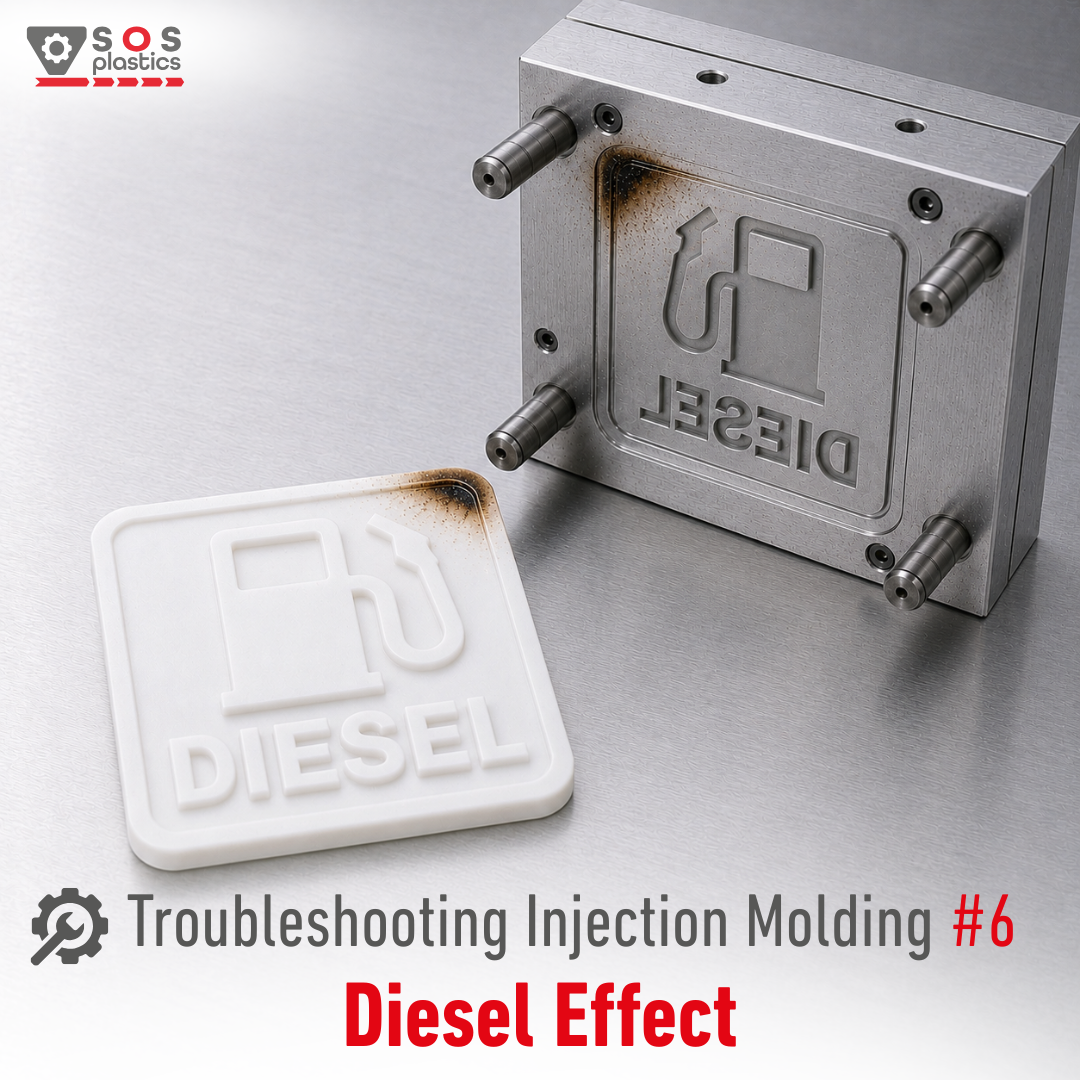
Diesel Effect occurs when air becomes trapped inside the mold cavity during filling. As the melt front advances, the trapped air is compressed into an increasingly smaller volume. Just like in a diesel engine, rapid compression dramatically raises the air temperature, which can become high enough to scorch or even carbonize the polymer.
The result is typically:
❌ black or dark brown burn marks,
❌ carbonized material,
❌ degraded polymer,
❌ unpleasant burnt odor,
❌ and in severe cases, weakened mechanical properties.
When troubleshooting Diesel Effect, it is important to investigate the causes in the right order:
1️⃣ Insufficient mold venting (Most Common Cause)
If trapped air cannot leave the cavity, pressure rises rapidly until the air reaches ignition temperatures.
➜ Clean existing vents, inspect vent depth and add venting where air is trapped. Consider adding additional vents or vent pins in the last-to-fill areas.
2️⃣ Injection speed too high
High filling speed compresses trapped air much faster, increasing the temperature before the air has time to escape.
➜ Reduce first stage injection speed or apply a filling profile that allows air to escape before it is compressed.
➜Compare the burn severity before and after reducing speed.
If the defect improves immediately, trapped air is very likely the root cause.
3️⃣ Air traps created by part geometry
Deep ribs, blind pockets, sharp corners and enclosed sections naturally trap air.
Even a perfectly vented mold cannot always evacuate air from a poor part design.
➜ Review the filling pattern.
➜ Use Moldflow or similar simulation to identify air traps.
➜ Modify wall transitions or add venting opportunities if redesign is possible.
4️⃣ Gate location forces air into Dead Zones
Sometimes the process is correct, but the melt flow pushes air directly into an area where it cannot escape.
➜ Evaluate gate position.
➜ Consider relocating the gate or adding secondary gates.
➜ Optimize the filling pattern to move trapped air toward existing vents.
5️⃣ Material Degradation (Secondary Cause)
Not every burn mark is Diesel Effect.
If discoloration appears randomly rather than consistently at the last-to-fill location, excessive residence time, high melt temperature or thermal degradation inside the barrel may be responsible.
➜ Verify residence time.
➜ Check barrel temperature profile.
➜ Inspect screw recovery and back pressure.
➜ Confirm that the material is not degrading before entering the mold.
Next in the Plastic Troubleshooting Series:
➜ Black Specks
Have you ever solved a Diesel Effect issue by improving venting instead of changing processing parameters? Share your experience in the comments.