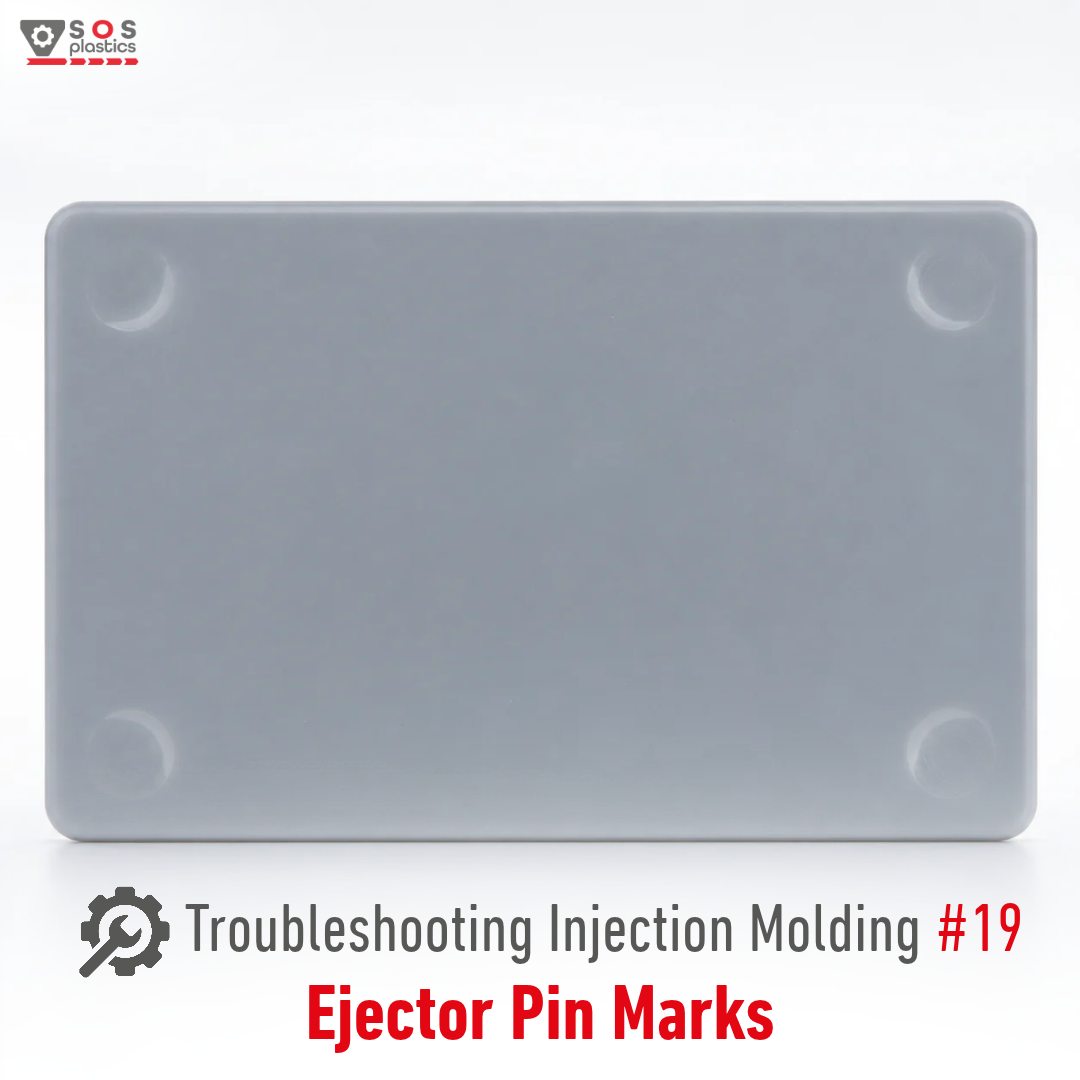
Ejector pin marks are visible depressions, raised areas, whitening or gloss differences around the ejector locations. They appear when the force required to release the part is too high, the part is still too soft, or the ejection force is concentrated over too small an area.
When troubleshooting Ejector Pin Marks, investigate the causes in the right order:
1️⃣ The part is not cold/stiff enough at ejection
➡️ Verify actual mold temperature, cooling balance and cooling time. Pay particular attention to thick sections and areas around gates or bosses.
➡️ Increase cooling time and optimize mold temperature/cooling within the material supplier’s recommended window.
2️⃣ Cavity/holding pressure is too high
➡️ Excessive packing can increase the contact pressure between the molded part and the mold, increasing the force required for ejection.
➡️ Check the V/P changeover and holding pressure/time. Reduce packing where possible without compromising part dimensions.
3️⃣ The part is gripping the mold too strongly
➡️ Check draft angles, undercuts and mold surface condition. Insufficient draft and high friction can significantly increase ejection force.
➡️ Improve draft, reduce undercuts or optimize the mold surface where required.
4️⃣ Ejection force is concentrated over too small an area
➡️ Check ejector pin diameter, quantity and position. Small pins create higher local pressure on the part.
➡️ Increase pin diameter or distribute the ejection load with additional pins, sleeves or other suitable ejection solutions.
5️⃣ The mold or ejection system has a mechanical problem
➡️ Check mold rigidity, ejector pin alignment, pin fit and local temperature differences. A poorly supported or unevenly cooled area can make an otherwise acceptable ejection system produce visible marks.
➡️ Correct the mechanical or thermal imbalance before simply increasing ejector force.
⚠️ Look at the ejector system as a load-distribution system.
The question is not only how much force is used, but also where and over what area that force is transferred into the part.
Next in the Plastic Troubleshooting Series:
➡️ Oil Stain
Have you ever solved an Ejector Pin Mark problem without changing the ejector pins themselves?