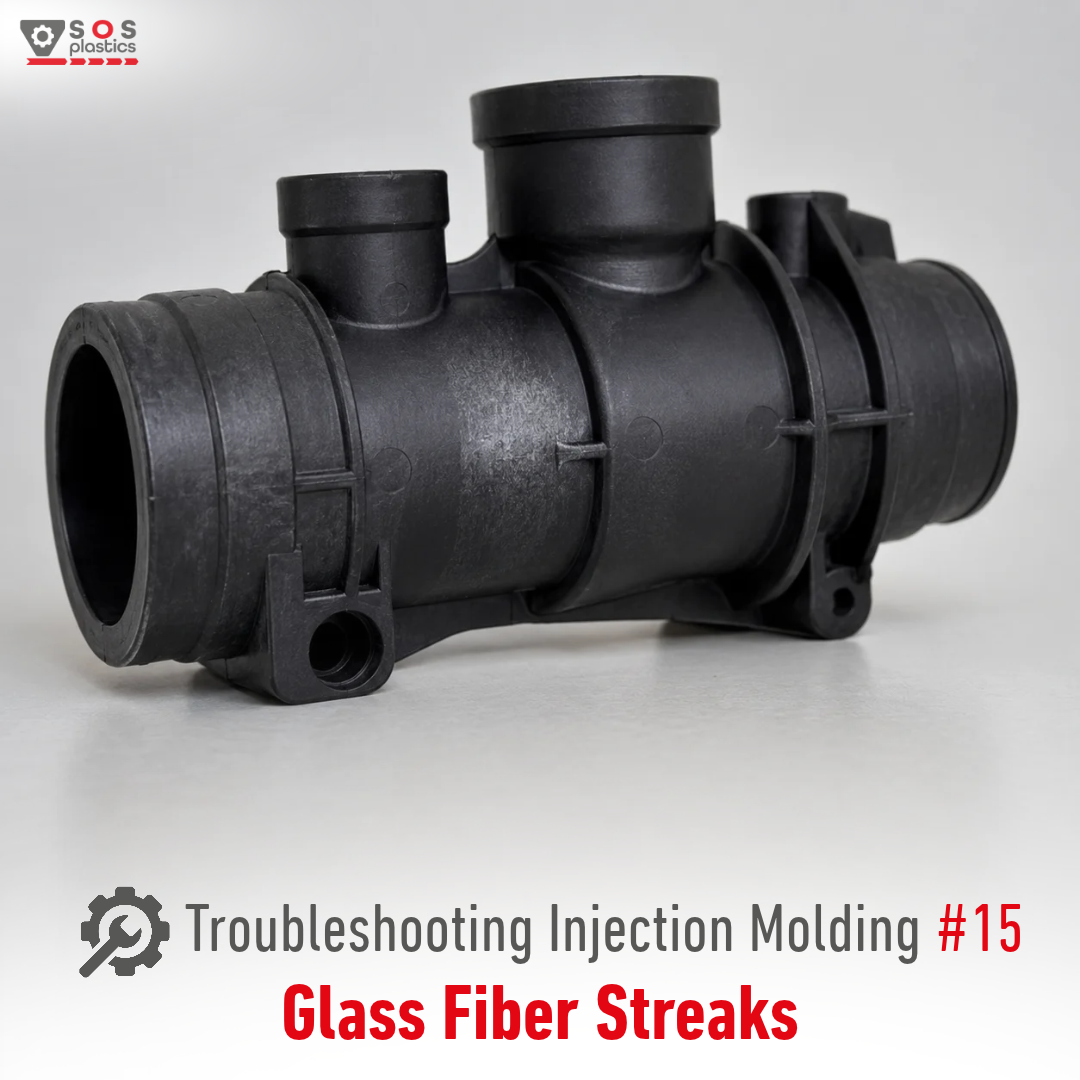
This time… a defect that can be particularly frustrating on glass-filled materials, especially when surface appearance matters.
Glass fiber streaks are rough, matt, mottled or sometimes metallic-looking surface areas caused by the interaction between fiber orientation, melt flow, cooling and differential shrinkage. They are especially common around openings, ribs, thickness changes, flow diversions and weld-line areas.
When troubleshooting Glass Fiber Streaks, investigate the causes in the right order:
1️⃣ The melt freezes too quickly at the mold wall
➡️ If the polymer skin solidifies before the glass fibers are properly surrounded by the matrix, fibers can become visible at the surface.
➡️ Check the actual melt temperature and mold-surface temperature, not only machine setpoints.
➡️ Increase melt and/or mold temperature within the material supplier’s recommended processing window.
2️⃣ The filling process is too slow or poorly profiled
➡️ A slow flow front gives the material more time to cool before the cavity is filled, increasing the risk of surface defects.
➡️ Increase injection speed or optimize the injection profile so the melt reaches the critical areas before excessive freezing occurs.
3️⃣ Fiber orientation changes because of the part geometry
➡️ Check whether the defect follows a specific geometric feature or flow pattern. If it does, the root cause may be the part or mold design, not simply the process settings.
4️⃣ Packing and shrinkage differences make the surface irregular
➡️ Optimize holding pressure and holding time to improve compensation during solidification.
5️⃣ The runner or gate creates excessive shear
➡️ Check gate and runner dimensions, transitions and radii. Where possible, increase the radius and/or size of the runner or gate.
⚠️ If the defect remains, look at the material itself. Shorter glass fibers can reduce the tendency for visible streaking, although this must always be balanced against the required mechanical performance. Gate relocation can also move the defect into a less visible area.
⚠️ Glass fiber streaks are often a design–material–process interaction.
If the defect consistently appears at the same geometric feature, changing machine settings may only mask the problem. The real solution may be a different gate position, runner geometry, part design or material grade.
⚠️ Surface appearance and mechanical performance must be considered together.
Next in the Plastic Troubleshooting Series:
➡️ Delamination
hashtag#SOSPlastics hashtag#InjectionMolding hashtag#PlasticTroubleshooting hashtag#GlassFiberStreaks