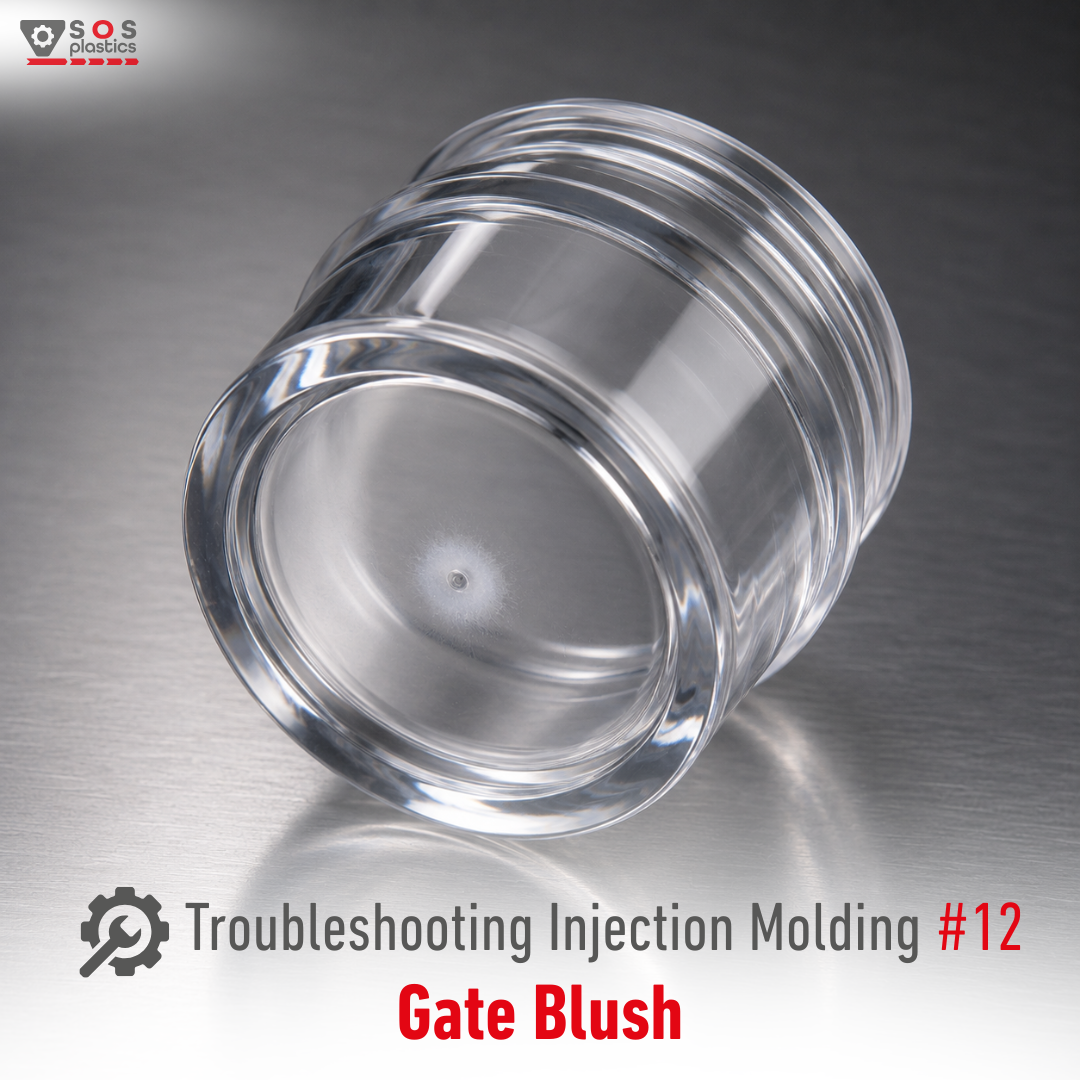
One small white mark around the gate can tell you a lot about your process.
The challenge is knowing what to look for first.
Gate Blush is a whitish or dull area visible around the gate, typically caused by unstable fountain flow or excessive shear during cavity filling.
When troubleshooting Gate Blush, investigate the causes in the right order:
1️⃣ Excessive shear at the gate (most common root cause)
➡ Verify the injection speed profile and gate dimensions. Reduce the initial filling speed or increase the gate size if possible.
2️⃣ Gate design too restrictive
➡ Inspect the gate thickness, gate land length and gate type. A small or restrictive gate creates excessive shear and unstable melt flow.
3️⃣ Incorrect melt or mold temperature
➡ Measure the actual melt and mold temperatures. Both excessively low and excessively high melt temperatures can contribute to Gate Blush. Optimize the process based on measured values rather than machine settings.
4️⃣ Improper filling profile
➡ Avoid maximum injection speed at the beginning of filling. A slower initial filling stage often improves fountain flow and eliminates the defect.
5️⃣ Premature gate freeze or insufficient packing
➡ Verify holding pressure, holding time and gate freeze time. Ensure the gate remains open long enough for proper packing.
⚠️ Gate Blush is often confused with Jetting. Jetting produces snake-like flow marks extending into the cavity, while Gate Blush remains localized around the gate.
⚠️ If reducing the initial injection speed significantly improves the defect, excessive shear at the gate is usually the root cause.
⚠️ Gate Blush is especially common on cosmetic parts where surface appearance is critical. These parts are often molded through very small pinpoint gates, making the gate area particularly susceptible to this defect.
Next in the Plastic Troubleshooting Series:
➡ Jetting
In your experience, is Gate Blush usually solved by process optimization, or does it often require gate modification?